Table of Contents
ToggleSmall living rooms don’t mean sacrificing style or comfort. A curved sectional can actually work better than traditional straight-back sofas in tight quarters, they guide foot traffic, soften corners, and create conversation zones without harsh angles eating up floor space. But not all curved sectionals are built for compact rooms. The wrong dimensions or bulky arms can make a small space feel claustrophobic instead of cozy. This guide walks through what makes a curved sectional work in limited square footage, from sizing and features to placement strategies that maximize every inch.
Key Takeaways
- A curved sectional for small spaces improves traffic flow, softens visual corners, and creates conversation zones more effectively than straight or L-shaped sofas.
- Choose a curved sectional with a shallow depth (30–34 inches), narrow arms, and exposed legs that are 4–6 inches tall to maximize visual space and walkability.
- Gentle arc radii (120–140 degrees) work best in compact rooms, while tighter curves need more floor space and can feel cramped.
- Placement strategy matters: float the sectional 12–18 inches off the back wall in square rooms, anchor it in a corner for rectangular layouts, or angle it diagonally in narrow spaces.
- Opt for light-colored, smooth-textured upholstery like linen or cotton blends and avoid heavy details like tufting or nailhead trim to keep the room feeling open and airy.
- Always measure clearances, use painter’s tape to outline the footprint before delivery, and ensure at least 30–36 inches of walkway width for comfortable passage.
Why a Curved Sectional Is Perfect for Compact Living Rooms
Curved sectionals solve a fundamental problem in small spaces: how to seat multiple people without blocking pathways or creating visual barriers. The gentle arc naturally defines zones while maintaining flow.
Traffic flow improvement is the biggest functional win. Unlike L-shaped or straight sectionals that force people to navigate around sharp corners, a curved profile guides movement along its contour. This is especially valuable in studio apartments or open-plan layouts where the sofa needs to separate living and sleeping areas without walling them off completely.
The visual softness matters more than most people realize. Hard angles and straight lines fragment a room visually, your eye stops at each corner. A curve keeps sight lines moving, which makes the room feel larger than its actual footprint. This psychological trick is why many designers favor rounded furniture for compact living solutions.
Curved sectionals also create natural conversation seating. Everyone faces slightly inward, which beats the awkward side-by-side arrangement of a straight sofa. If you’re hosting in a small apartment, that seating geometry means more people can interact comfortably without rearranging furniture.
One often-overlooked benefit: corner efficiency. A curved sectional floats better in a room corner than an L-shaped piece. You can tuck it into an alcove or against two walls without the dead space that accumulates behind a 90-degree sectional joint. That recovered space can fit a floor lamp, side table, or plant stand, items that would otherwise crowd the room.
Key Features to Look for in a Small-Space Curved Sectional
Not every curved sectional is scaled for a compact room. Focus on these practical features before you measure or shop.
Size and Scale Considerations
Overall depth is the first dimension to check. Standard sectionals run 36–40 inches deep: look for models in the 30–34 inch range instead. Those few inches make a noticeable difference when you’re trying to maintain a walkway behind the sofa. Shallow-depth pieces still offer comfortable seating, they just skip the sprawling chaise extension.
Pay attention to arm width. Track arms (straight, boxy profiles) typically measure 4–6 inches wide. Rounded or English arms can add 8–10 inches per side. In a small room, that’s 12–16 inches of seating surface lost to arm styling. If the room is under 150 square feet, prioritize narrow or no-arm designs.
Seat height affects how the piece reads visually. Low-profile sectionals (seat height 16–18 inches) create the illusion of more vertical space, which helps in rooms with standard 8-foot ceilings. Higher seats (19–21 inches) can feel imposing unless you have tall ceilings or very long legs.
Check the curve radius. A gentle, wide arc (120–140 degrees) works in most small spaces. Tight curves (160+ degrees, nearing a full circle) look dramatic but need more floor space to avoid feeling cramped. Measure the chord length, the straight-line distance from one end of the curve to the other, and make sure it’s at least 12 inches shorter than your wall length to allow breathing room.
Consider modular vs. single-piece construction. Modular curved sectionals break into two or three segments that connect with clips or brackets. They’re easier to move through narrow doorways and up stairwells (standard door openings are 30–32 inches wide: check your sofa’s widest point). Single-piece construction is sturdier but can be a logistical nightmare in a walk-up apartment.
Storage and Multi-Function Options
In a small space, every piece of furniture should earn its footprint. Look for curved sectionals with under-seat storage. Lift-top compartments (usually under the chaise or center section) can hold throw blankets, board games, or off-season linens. Storage adds weight and slightly increases seat height, so test the lift mechanism, cheap gas struts fail within a year.
Sleeper sectionals are tempting, but be realistic about how often you’ll use the bed function. Pull-out mechanisms require clearance in front of the sofa (typically 24–36 inches) to fully extend. If your coffee table is permanently 18 inches away, you’ll need to move it every time. Pop-up sleepers (where the seat cushions fold flat and a mattress unfolds) are easier but less comfortable for overnight guests.
Some curved sectionals offer removable back cushions that double as floor seating. This works well if you host game nights or kids’ sleepovers, just don’t expect them to hold their shape after heavy use. Down-blend or high-resilience foam cushions recover better than polyester fiberfill.
Pair your sectional with furniture that complements tight layouts, like nesting tables or ottomans that slide under the curve when not in use.
Best Placement Strategies for Curved Sectionals in Tight Spaces
Placement makes or breaks a curved sectional in a small room. Get it wrong and you’ll block windows, crowd doorways, or create awkward dead zones.
Float it in the center if your room is square or nearly square (12×12 or 14×14 feet). Floating the sectional 12–18 inches off the back wall creates a walkway behind the sofa, which visually expands the space and gives you room for a console table or bookshelf. This works best in open-plan studios where the sofa acts as a room divider.
Anchor it in a corner for rectangular rooms (10×16 or similar). Position the curve’s apex in the corner and let the ends angle out along the two walls. Leave at least 24 inches of clearance between the sofa ends and adjacent furniture (like a TV stand or side table) to avoid a cluttered look. Many homeowners embracing space-conscious furniture arrangements use this layout to define living zones.
Angle it against one wall for narrow rooms (9×18 or galley-style layouts). Push one end of the curve flush against the long wall and let the opposite end angle into the room at roughly 30–45 degrees. This creates a diagonal sight line that makes the room feel wider. It’s unconventional, but designers at Homedit often showcase this trick in small-space makeovers.
Avoid placing the sectional directly under windows. You’ll lose natural light, and the sofa back will block sight lines to the outdoors, one of the few ways to make a small room feel less confined. If the room has only one usable wall and it’s windowed, consider a low-back curved sectional (back height under 30 inches) so light can flow over it.
Map the clearance before you commit. You need 30–36 inches of walkway width for comfortable passage (per IRC accessibility guidelines, though this applies to all homes, not just ADA-compliant builds). Measure from the sofa’s deepest point to the nearest obstacle (coffee table, TV stand, wall). If you’re under 24 inches anywhere, rethink the layout or choose a shallower sofa.
One pro tip: use painter’s tape on the floor to outline the sectional’s footprint before delivery. Sit in the taped area, walk around it, and visualize daily routines (carrying laundry, vacuuming, opening closet doors). If the tape layout feels tight, the real sofa will feel worse.
Style and Material Choices That Maximize Space
Material and color choices influence how heavy or airy a curved sectional feels in a small room. The wrong upholstery or leg style can make even a perfectly sized sofa look bulky.
Light-colored upholstery reflects more light and recedes visually. Soft grays, beiges, taupes, and warm whites are safe bets. Darker fabrics (navy, charcoal, forest green) can work if you have excellent natural light or high ceilings, but they’ll shrink the perceived floor space in dim rooms. If you love bold color, use it in accent pillows instead of the base upholstery.
Texture matters as much as color. Smooth fabrics like linen, cotton blends, or microfiber feel less visually dense than chunky wools or heavily textured boucles. Velvet sits somewhere in the middle, it’s plush but catches light in a way that adds dimension without bulk. Contemporary furniture spotlights on Design Milk often favor linen-upholstered curves for compact urban spaces.
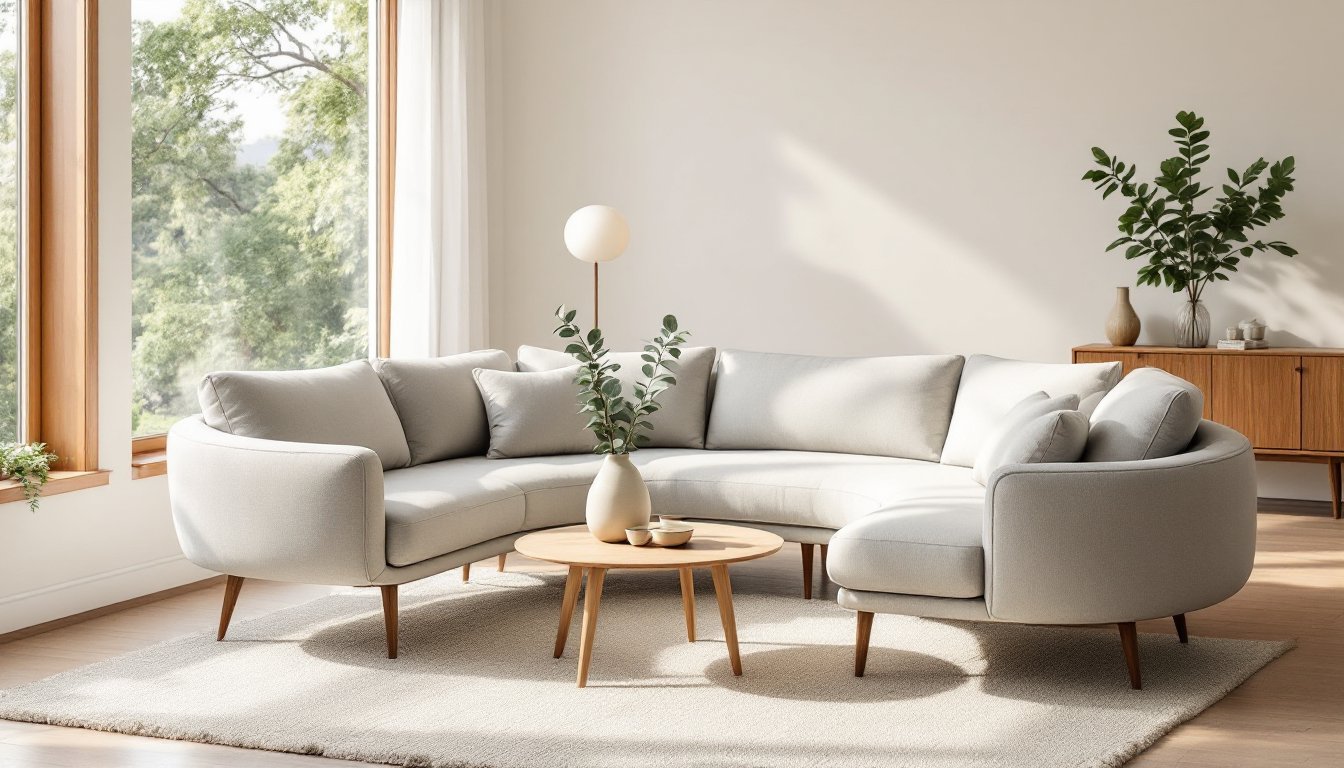
Exposed legs are a game-changer. Sofas with visible wood, metal, or acrylic legs create negative space underneath, which makes the piece look lighter and allows light to pass through. Skirted or fully upholstered-to-the-floor sectionals (sometimes called “sock-arm” or “tight-back” styles) can look heavy and trap dust. Aim for legs at least 4–6 inches tall, enough to see floor underneath but not so high that the sofa feels spindly.
Leg material affects style coherence. Tapered wood legs (walnut, oak, or painted finishes) suit mid-century and Scandinavian interiors. Hairpin or angled metal legs lean modern or industrial. Acrylic legs (sometimes called “lucite”) are nearly invisible and work with any style, though they scratch easily and show fingerprints.
Cushion style subtly impacts visual weight. Tight-back cushions (attached, non-removable) create clean lines and less visual clutter than loose pillow-back styles. Loose cushions offer more comfort customization (you can flip or fluff them) but can look rumpled. If you’re short on time or prefer low-maintenance furniture, tight-back wins.
Avoid heavy details: rolled arms, tufted backs, nailhead trim, and ornate wood carvings all add visual mass. They’re beautiful in spacious traditional homes but overwhelm a 200-square-foot living room. Stick with streamlined profiles, track arms, straight seams, minimal embellishment.
Finally, coordinate with other furniture for a cohesive look. If your sectional has wood legs, echo that wood tone in your dining furniture or side tables. Mixing too many materials (chrome, brass, black metal, walnut, and white oak) fragments the space and makes it feel smaller.
Conclusion
A curved sectional can transform a cramped living room into a functional, inviting space, if you choose the right scale, features, and placement. Prioritize shallow depths, narrow arms, and exposed legs to keep sight lines open. Float or angle the sofa to improve traffic flow, and stick with light upholstery and minimal detailing to avoid visual clutter. Measure twice, tape the footprint, and don’t skip the clearance check. Done right, a curved sectional makes a small space feel intentional, not squeezed.